About 
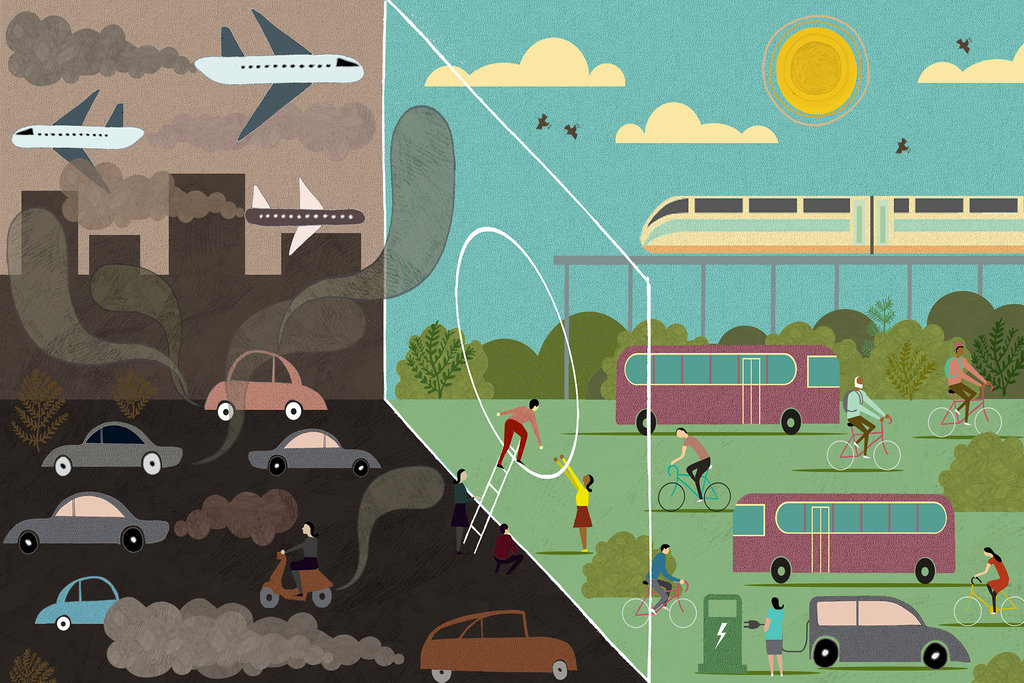
Although a sharp drop in CO2 emissions has been observed in the last year, this is largely a temporary bliss. But it also serves to show that it is problem that can be solved. According to United Nations' Enivronmental Program's (UNEP) Emissions Gap Report 2020 2rd's of global emissions are linked to private households primarily in developed nations. This footprint needs to be reduced atleast by a factor of 30 to stay inline with the Paris Agreement targets.
This can be done by changing consumption habits and developing a sustainable lifestyle. This app serves as an accounting tool to help people make informed decisions about their lifestyle choices.
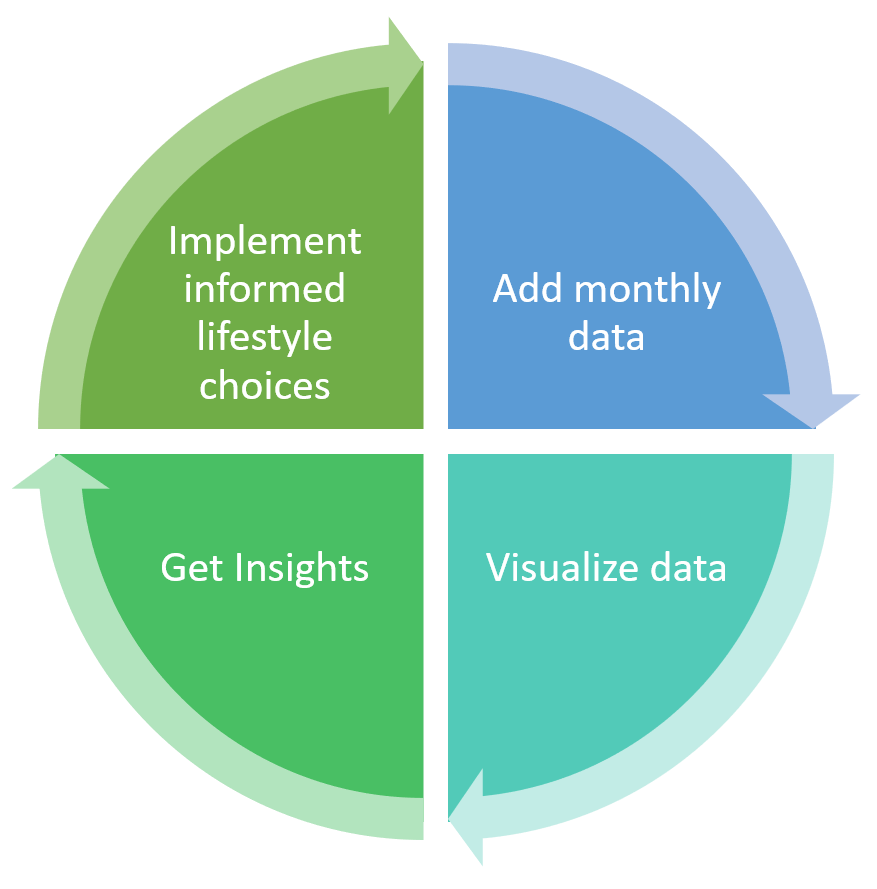
By using CO2-eq values from various sources, it takes in basic everday metrics (kg, km, kwh etc.) and calculates their estimated carbon emissions. By using visualization, progress can be monitored on a graph of monthly carbon emissions and biggest sources can be identified by the bar chart. Users can also keep track of their total cumulative emissions for the year.
This will help users implement better lifestyle choices to reduce their footprint. Learn more about how to reduce carbon footprint.
Sources
1. Greenhouse Gas Emissions from Ruminant Supply Chains – A Global Life Cycle Assessment.
2. Jensen, Jesper Kronborg, and Jan Stentoft Arlbjørn. “Product Carbon Footprint of Rye Bread.” Journal of Cleaner Production, vol. 82, 2014, pp. 45–57., doi:10.1016/j.jclepro.2014.06.061.
3. “Average CO2 Emissions from New Cars and New Vans Increased in 2018.” European Environment Agency, 23 Nov. 2020, www.eea.europa.eu/highlights/average-co2-emissions-from-new.
4. Sims R., R. Schaeffer, F. Creutzig, X. Cruz-Núñez, M. D’Agosto, D. Dimitriu, M.J. Figueroa Meza, L. Fulton, S. Kobayashi, O. Lah, A. McKinnon, P. Newman, M. Ouyang, J.J. Schauer, D. Sperling, and G. Tiwari, 2014: Transport. In: Climate Change 2014: Mitigation of Climate Change. Contribution of Working Group III to the Fifth Assessment Report of the Intergovernmental Panel on Climate Change [Edenhofer, O., R. Pichs-Madruga, Y. Sokona, E. Farahani, S. Kadner, K. Seyboth, A. Adler, I. Baum, S. Brunner, P. Eickemeier, B. Kriemann, J. Savolainen, S. Schlömer, C. von Stechow, T. Zwickel and J.C. Minx (eds.)]. Cambridge University Press, Cambridge, United Kingdom and New York, NY, USA.
5. Dr. William H. Schlesinger President Emeritus, et al. “Food Energy.” Cary Institute of Ecosystem Studies, 19 Nov. 2019, www.caryinstitute.org/news-insights/blog-translational-ecology/food-energy.
6. Moudrý, Jan, et al. “Assessing Greenhouse Gas Emissions from Potato Production and Processing in the Czech Republic.” Outlook on Agriculture, vol. 42, no. 3, 2013, pp. 179–183., doi:10.5367/oa.2013.0138.
7. Zaekhan, Zaekhan, and Nachrowi D. Nachrowi. “The Lmpact of Renewable Energy and GDP per Capita on Carbon Dioxide Emission in the G-20 Countries.” Economics and Finance in Indonesia, vol. 60, no. 2, 2015, p. 145., doi:10.7454/efi.v60i2.71.
8. Greenhouse Gas Emissions, www.hydropower.org/resources/factsheets/greenhouse-gas-emissions.
9. “Solar, Wind and Nuclear Have 'Amazingly Low' Carbon Footprints, Study Finds.” Carbon Brief, 8 Dec. 2017, www.carbonbrief.org/solar-wind-nuclear-amazingly-low-carbon-footprints.
10. Bonafin, Joseph et al. “CO2 emissions from geothermal power plants: evaluation of technical solutions for CO2 reinjection.” (2019).
11. The Carbon Footprint of Domestic Water Use in the Huron River Watershed. www.hrwc.org/wp-content/uploads/Carbon-Footprint-brochure_single-pages.pdf.
12. Hacker, Jacob N., et al. “Embodied and Operational Carbon Dioxide Emissions from Housing: A Case Study on the Effects of Thermal Mass and Climate Change.” Energy and Buildings, vol. 40, no. 3, 2008, pp. 375–384., doi:10.1016/j.enbuild.2007.03.005.
13. Acquaye, Adolf A., et al. “Stochastic Hybrid Embodied CO2-Eq Analysis: An Application to the Irish Apartment Building Sector.” Energy and Buildings, vol. 43, no. 6, 2011, pp. 1295–1303., doi:10.1016/j.enbuild.2011.01.006.
14. Jeong, Young-Sun, et al. “Estimation of CO2 Emission of Apartment Buildings Due to Major Construction Materials in the Republic of Korea.” Energy and Buildings, vol. 49, 2012, pp. 437–442., doi:10.1016/j.enbuild.2012.02.041.
15. “Rentals.ca February 2019 National Rent Report.” Rentals.ca, rentals.ca/blog/rentals-ca-february-2019-rent-report.
16. “Environmental Impact of the IPhone – Orchard: Blog.” Orchard, 30 Nov. 2020, www.getorchard.com/blog/environmental-impact-of-the-iphone/.
17. Engineer, Srilatha Manne Principal Hardware, et al. “Examining the Carbon Footprint of Devices.” Sustainable Software, 23 Nov. 2020, devblogs.microsoft.com/sustainable-software/examining-the-carbon-footprint-of-devices/.
18. “Modeling the Carbon Footprint of Wood-Based Products and Buildings.” The Carbon Footprint Handbook, 2015, pp. 162–181., doi:10.1201/b18929-11.
Jkaybay, ~. “Daily Footprint, #7 –Home Appliances - How to Calculate Your Carbon Footprint.” The Green Stars Project, 21 Feb. 2020, greenstarsproject.org/2016/12/30/how-to-calculate-carbon-footprint-home-appliances/.